

Tuesday, May 5th, 2026
Writing to you from Uruguay
This past week in the Investor Cycle of The Preparation went well…
Apologies for being a little late on the update.
As I said before, I know practically nothing about investing, but I think that these past two weeks have given me a fairly solid initial glimpse into what investing looks like, how to do it, and how to look at the world through the eyes of an investor—at least to a certain degree.
Anyway, this past week ended with a good balance of analytical aspects of investing as well as a broader understanding of why investing today is much different than it was in, for example, Warren Buffett’s day.
What I Learned This Past Week
I’ll save the detailed (and more boring stuff) for later…
For now, it’s worth going over something incorrect on a broad scale: Current investing philosophy. Chances are you were taught or told, at one point or another, that all you’ve got to do to invest properly is put a portion of your income into the S&P 500, Apple stock, Microsoft, Google…
Maybe you were told about dollar-cost averaging: The idea that you should buy a certain stock or index on a regular basis.
Usually, the two ideas came together. Invest, let’s say, $500 dollars of your paycheck into the S&P 500 (a “trustworthy” and somewhat stable index that only seems to go up over time) and do it using dollar-cost averaging…meaning you continuously invest $500 of every paycheck into the index.
That’s essentially what I was told to do in school. Invest in “safe” stocks like Apple or Microsoft, keep your money there, and it’s a guaranteed win!
The other side of things (that’s also incorrect today) is the idea that long-term value investing is safe because “that’s what Warren Buffett did”. For context, value investing is basically its own philosophy, but to put it simply it’s about finding stocks that you think are undervalued currently but you think will have a higher value in the future. That is what Warren Buffett did and he earned a lot of money doing it.
So, now we have two ideas that tend to be presented together…
First, the thought that certain big-ticket companies or indexes are safe and will continue to steadily rise, therefore you should take the route of dollar-cost averaging. Yet, parallel to that idea is the “Warren Buffett did it so I can too” idea that you, too, can make hundreds of millions by steadily investing in companies like Apple, Microsoft…
These ideas aren’t bad. In fact, without inflation or any other external distortion these ideas are not only sound, but useful too.
The other thing is…without the financial or economic distortions (such as the closing of the gold window in 1971, which cut the tie between the price of gold and value of the dollar) caused by the banks and the government, Warren Buffett wouldn’t have been nearly as rich as he is today. He was born at the right time when the dollar had real value, he invested at the right time, he stuck to his philosophy of value investing. With huge bursts of sudden inflation in the 70s and 80s the stocks he had been holding onto largely went up in price simply because the money supply was larger.
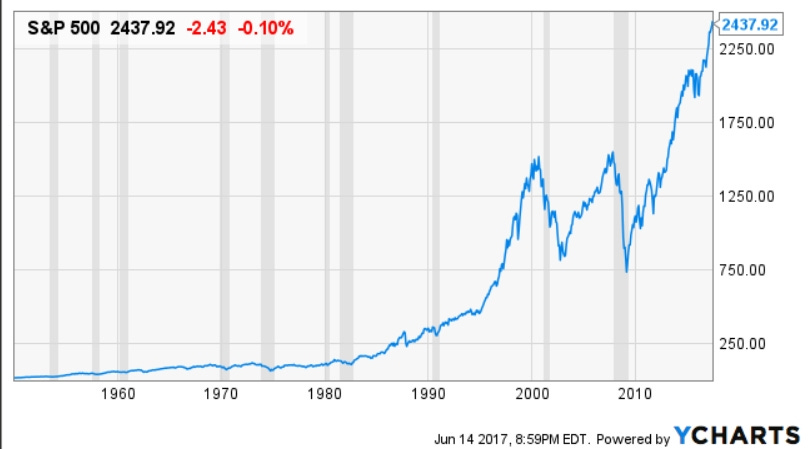
Take this chart of the S&P 500 for example…
The growth it has seen in nothing short of unnatural. So, you’ve got to ask yourself…would Warren Buffett have even gotten close to being as rich as he is without external factors driving distortion.
I bring this up because Warren Buffett has, for my entire life, been hailed as an absolute untouchable genius. If anyone aims to delve into investing his image and philosophy is shoved in your face. Did he do an excellent job of making do with what he had, completely understanding fundamental analysis, and sticking to his guns with value investing? Yes.
Does his method work anymore? No.
You’ll be lucky if any of your long-term investments outpace inflation.
What I Find Interesting
This is what’s interesting to me: learning about the bigger picture, how things actually work, to be able to slowly put the pieces of the puzzle together to understand not only what is right and wrong, but also understand what actually works and what doesn’t.
The week before last allowed for a look into the 3 main forms of inflation: fractional reserve banking, quantitative easing, and government bonds.
Check out the last post in the Investor Cycle to read more on this topic:

Inflation, especially at the degree we have to face it in the states now, is a macro-scale problem that affects investing as a whole. Does it tell you where to invest your money? Of course not. Yet, understanding problems and changes gives you a better idea of how to invest your money.
The Detail Side of Things
This is the boring stuff. I’m going to fly through it because spending a ton of time on any of this.
Here’s a few terms I learned this past week:
ROIC: Return on Invested Capital measures the percentage return a company earns on the capital invested by its shareholders and debt holders, reflecting how efficiently it generates profits from its invested capital.
ROE: Return on Equity measures profitability relative to shareholders’ equity; key for investors and analysts. (ROE= Net income/shareholder equity)
EBITDA: Earnings Before Interest, Taxes, Depreciation, and Amortization measures a company’s core operational performance.
DCF: Discounted Cash Flow is a method to determine the intrinsic value of a company.
P/E: Price to Earnings Ratio is a financial metric that compares a company’s stock price to its earnings per share (EPS). It indicates how much investors are willing to pay for each dollar of earnings. (The formula is: P/E Ratio = Share Price ÷ Earnings Per Share)
P/S: Price to Sales Ratio is a metric to measure a company’s stock price to its total sales or revenue. (Formula: P/S Ratio= share price/sales per share)
P/B: Price to Book Ratio compares a company’s current market value to its book value, which is the net value of its assets after subtracting liabilities.
All of these terms and methods for measuring the value of a company (which I learned from the Stock Market Investing for Beginners course) came together to help me read financial statements and make judgements about a company from them.
Activities
Chess practice (6 out of 7 days)
Still doing alright with chess. Hit a small plateau recently, but I think that’s just due to my occasional lack of patience and ability to slow down and really think about a set of circumstances. Practice is needed.
Guitar practice (6 out of 7 days)
No comments here. Still going ok.
Working out (6 out of 7 days)
Still doing a mix of weightlifting, running, and at-home Muay Thai.
Reading
Finished reading Passin’ Through by Louis L’Amour

Finished reading The Dao of Capital by Spitznagel
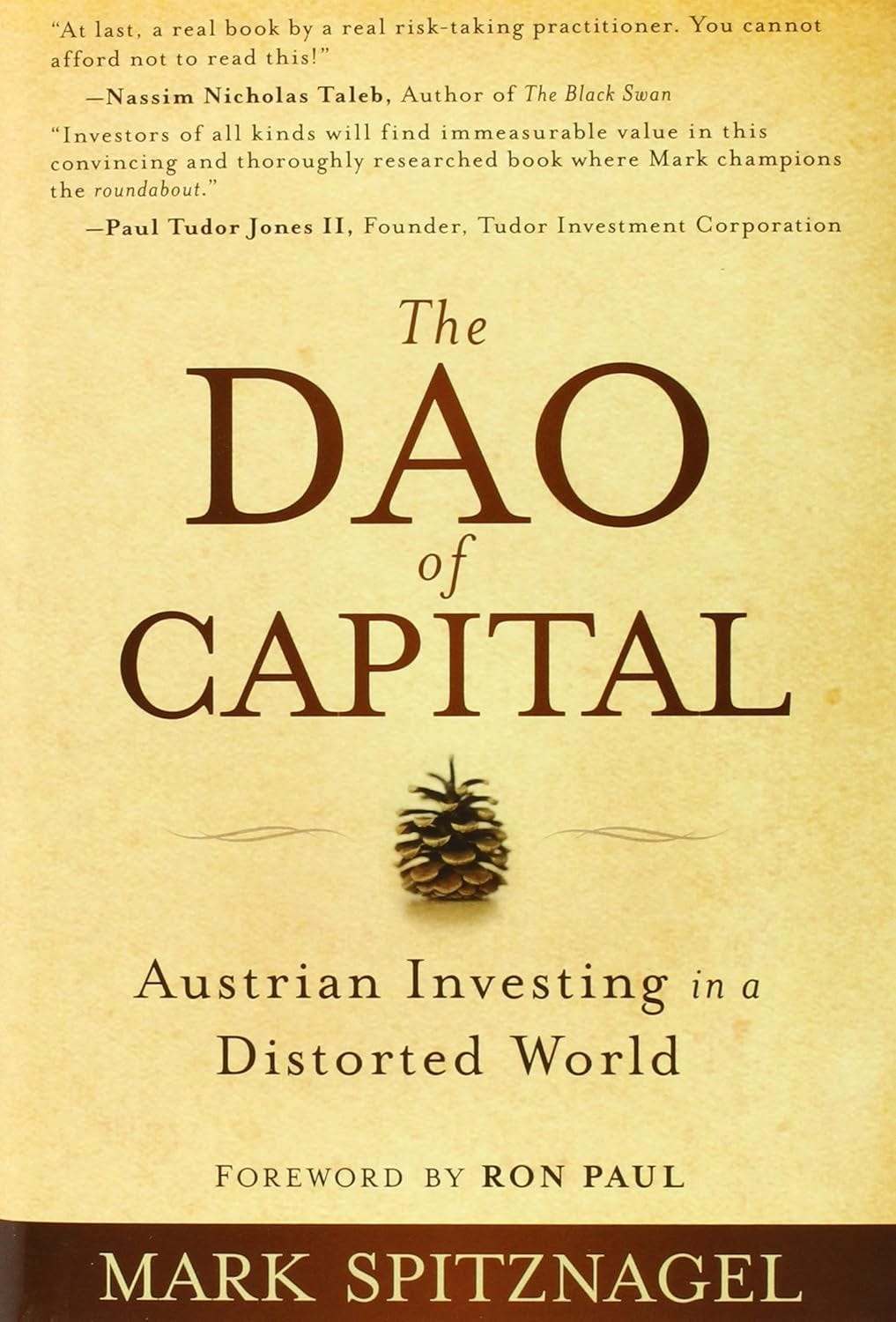
This was a good book. It’s worth reading because it gives you a clear idea of how one should think about investing. It’s not a technical book by any means…more of a philosophical book.
Things I Published
Are these updates informative? Are they useful? Entertaining?
Leave a comment below if you’ve got any suggestions or questions for me.
And don’t forget to send this to someone who might benefit.
I’ll see you next week.
-Maxim Benjamin Smith
I am acting as a guinea pig for a program which is meant to prepare young men for the future. This program is designed to be a replacement for the only three routes advertised to young men today - go to college, the military, or a dead-end job.
All of these typical routes of life are designed to shape us into cogs for a wheel that doesn’t serve us. Wasted time, debt, lack of skills, and a soul crushing job define many who follow the traditional route.
This program, which we can call “The Preparation”, is meant to guide young men on a path where they properly utilize their time to gain skills, build relationships, and reach a state of being truly educated. The Preparation is meant to set young men up for success.
What appeals to me about The Preparation is the idea of the type of man I could be. The path to becoming a skilled, dangerous, and competent man is much more clear now. I’ve always been impressed by characters like The Count of Monte Cristo, men who accumulated knowledge and skills over a long period of time and eventually became incredibly capable men.
Young men today do not have a guiding light. We have few mentors and no one to emulate. We have been told that there are only a few paths to success in this world. For intelligent and ambitious people - college is sold to us as the one true path. And yet that path seems completely uncertain today.
We desperately need something real to grab onto. I think this is it.
I’m putting the ideas into action. Will it work? I can’t be sure, but I’m doing my best. I’m more than 60 weeks into the program at this point. So far, so good.
You can follow me along as I follow the program. Each week, I summarize all that I did.
My objective in sharing this is three fold:
Documenting my progress holds me accountable.
I hope these updates will show other young men that there is another path we can take.
For the parents who stumble upon this log, I want to prove to you that telling your children that the conventional path - college, debt, and a job is not the foolproof path you think it is.
You have direct access to two of the best teachers. Your dad and Doug Casey.
Mr. Smith,
For someone your age, I find your knowledge to be outstanding! I am a retired engineer who has two ideas I would like to share with your community. At the age of 16, I was gifted a "Peter Wright"
anvil by a mature former German friend who was in WW1 (he was the kid who dynamited trees for rail fuel on steam engines). (William Riser was his name). I became so invested in blacksmithing that I pursued a career in welding. The anvil still sits in my shop, along with many other tools (lathes, saws, welders, and a DRO Bridgeport mill). I would also include "investments" to be in good tools if one's involved with a career path in the "trades". They will never get cheaper!
In the 80's, my father ran a "paper converting company" that was one of the largest in the Midwest, and a major backer "Dick Behr" had to sell us, as his scrap businesses needed additional capital.
We were investigated by the Pitcairn Group, even though we were far too small for their consideration. They gave my father a bound publication which I read, and the notable features I gleaned was "all the businesses that involved some "vice" that they would not invest in". They were obviously "faith driven", so much so that they built a college for the education of all family members to attend! The family Pitcairn had two (I believe) family members who sat on the Board of Directors. THEY WOULD NOT INVEST IN VICE, (businesses that involved tobacco, liquor, pornography, etcetera)! They obviously believed that "where you put your money is in those places in what you believe in!" I wonder if they invest in Treasuries or not?
Just something to think about!
Best regards, and keep growing and learning!
Thank you for sharing your mission stories, you are on a Great Journey!