
The Crisis of Unearned Authority
What if merit didn't matter anymore?

“We have a major crisis on our hands.”
You’ve heard that a million times by now…
Economic crisis. Political crisis. Mental health crisis. Education crisis. Housing crisis.
Pick one.
But there’s another crisis that I’ve started noticing more and more over the last few years. One that shows up just about everywhere from the classroom to the cockpit and even to the fireline.
Crisis of Authority
Any good culture values merit.
We want to reward people who have proven themselves worthy of reward. We give them trophies, money, statues, influence, and—eventually—positions of authority.
At least that’s how it’s supposed to work.
The world opens up for people who prove they have merit.
Socrates had merit because he lived and died doing exactly what he preached. He acted virtuously no matter where he was or what was happening. He fought in the Peloponnesian War. He reportedly showed enough dignity and composure during a retreat to stop enemy soldiers from attacking him. He spent his life thinking, questioning, and teaching the youth of Athens to think for themselves.
Every act of his life added a little more weight to his words.
Eventually, he became someone worth listening to.
But never mind Socrates.
Your own grandfather might have been a man of high merit.
Maybe he never had a fancy title. Maybe he didn’t have a bunch of letters after his name. But his actions defined him. He’d been through enough, done enough, screwed up enough, and learned enough that when he spoke, you listened.
His authority was earned.
That’s an important distinction.
There’s positional authority and there’s earned authority.
Positional authority comes from a title.
Earned authority comes from merit.
Ideally, the two belong to the same person.
Increasingly, I don’t think they do.
Look around.
There are teachers who can’t teach. Managers who can’t lead. Officials who understand their rulebook better than the real world. People with degrees, licenses, certifications, years on the job, and every other piece of paper imaginable who you still wouldn’t trust to make an important decision for you.
Why?
Because we’ve started confusing the things that are supposed to represent competence with competence itself.
A certification can be useful. So can a license. So can a degree.
If I’m getting on an airplane, I’d certainly prefer the guy flying it to have a license.
But a certificate or license proves that you met a standard.
It doesn’t prove that you’re wise.
It doesn’t prove that you have good judgment.
It doesn’t prove that you’re a good leader.
And it definitely doesn’t prove that you deserve someone’s trust.
Somewhere along the way, we forgot the difference.
I could keep telling you what I mean, but I’d rather show you…
On the fireline
I’ve been the beta tester for an alternative to college called The Preparation for the last three years.
Because of it, I’ve been exposed to a lot of different worlds.
Muay Thai. Geophysics. Wildfires and EMS. Sailing. Flying. Ranching. Entrepreneurship.
Each one gave me a slightly different perspective on authority.
Two years ago, I was deployed to the Willamette fire complex in western Oregon as an EMT.
It was my second fire, and I was happy to be there.
Things were slow at first. My medic and I were stationed at fire camp working out of the med tent. For the first few days, all we really saw were bad blisters, a guy with his face covered in poison oak, and one 30-minute nosebleed.
Then a spot fire blew up a few hundred acres and they needed another ambulance to standby while hand crews, engines, and fallers went in to suppress it.
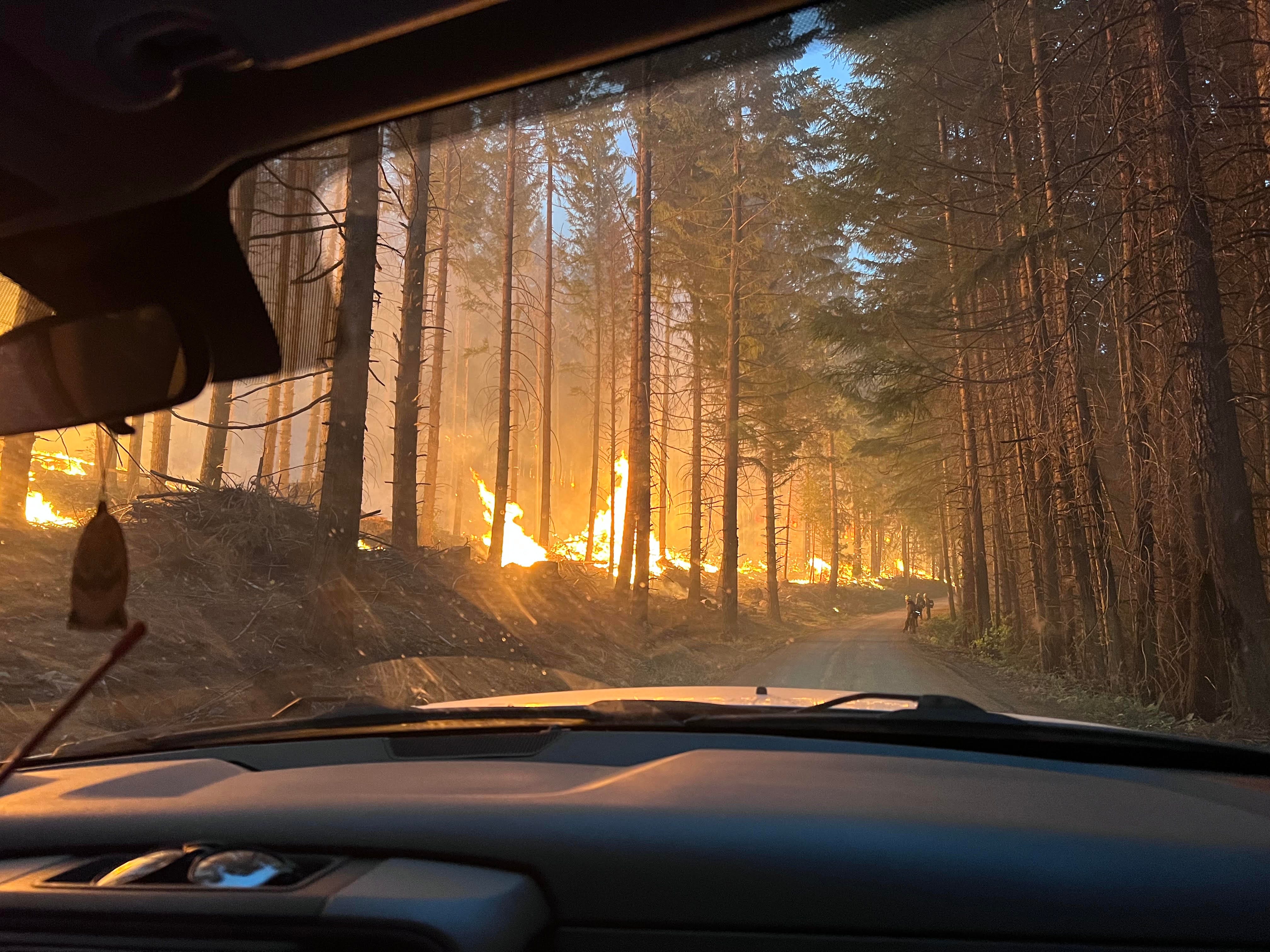
My medic and I got the assignment.
We were happy to get out of camp.
Day after day went by pretty slowly, as the medical side of wildland fire usually does. The fire grew enough to overtake a few of our drop points and push us farther back each day.
In the tinderbox that is a poorly managed PNW forest, there’s really no telling how crazy things can get.
So you have to be ready.
But by this point I had spent around two months total working in wildland fire, and something else was becoming clear to me:
A surprising number of the people running the show were clowns.
There was an incredible amount of chest-thumping, posturing, bad communication, and terrible leadership in a world where competence is supposed to be pretty important.
Sometimes it determines whether people get hurt or killed.
The thing that really burned the idea into my mind happened more than halfway through our 14-day roll.
A group of division leaders—the people responsible for coordinating resources across sections of a wildfire—met up near where my medic and I were stationed.
They were trying to figure out where they could get the best cell service.
Why?
So they could watch a college football game.
They eventually drove off, found somewhere with enough service, sat in their trucks, and watched the game.
No, I’m not kidding.
Meanwhile, the guys doing the grunt work were still out on the line.
The fire hadn’t disappeared, but the leaders did.
Now, let me be clear.
I haven’t been in wildland fire very long. There are guys out there right now with years more experience than I have.
I’ve also met some seriously competent leaders on fires. There almost always seems to be one diamond in the rough. One person who doesn’t need to tell everyone how important he is because everyone naturally starts relying on him when something needs to get done.
Those are the people worth watching.
But there are also a disproportionate number of bad leaders.
So how did they get there?
Usually, they went through the system.
Certification after certification.
Qualification after qualification.
Year after year.
Eventually they climbed high enough up the ladder to call the shots.
They “did the time.”
And doing the time matters.
But doing the time is only half the battle.
You can spend ten years doing something badly.
You can pass a course without becoming a leader.
You can collect qualifications without becoming wise.
You can become very good at working your way through a system without becoming very good at the thing the system is supposed to represent.
That’s the problem.
They proved they could work their way through the system.
Their actions are what prove whether they actually have merit.
In the cockpit

Flying opened me up to a whole new world.
Flight training almost closed me off to it.
Learning to fly sounded simple enough.
You train, log the necessary hours, pass your written exam, pass your checkride, and eventually get your Private Pilot’s License.
Plus, who wouldn’t want to know how to fly a small aircraft?
It’s probably one of the most interesting practical skills you can learn when you’re young.
So again, as part of The Preparation, I started learning how to fly in Colorado and eventually continued training in Uruguay.
I was excited.
But after rotating through six different instructors across two different countries, I kept running into basically the same problem.
Very few of them seemed particularly interested in actually teaching.
Some were way too hands-on.
Others barely did anything.
Some would take the controls constantly instead of letting me screw up and learn. Others seemed perfectly content to sit there while I flew around without explaining much of anything.
Eventually, I started to understand why.
For a lot of flight instructors, teaching isn’t the end goal.
It’s a way to build hours.
Professional aviation requires a huge amount of flight experience, and being a CFI is one of the ways you can get paid while accumulating those hours instead of spending thousands upon thousands of dollars buying them yourself.
That doesn’t mean CFIs are bad people.
It means the incentives are screwed up.
The student wants a great teacher.
The instructor needs flight hours.
Sometimes those interests line up perfectly.
Sometimes they don’t.
And once again, the system mostly measures something easy to count:
Hours.
How many do you have?
Get enough and you become eligible for the next thing.
Then the next.
Then the next.
Eventually, some of the people who are floating by and doing the bare minimum right now are going to be captains flying your plane.
Some will command firefighters.
Some will teach your kids.
Some will manage companies.
Some will become doctors, professors, politicians, military officers, bureaucrats, and every other figure of authority you can imagine.
That should make you think.
Because putting in the hours and actually learning from those hours are two completely different things.
Ten years of experience is not the same thing as one year of experience repeated ten times.
Yet our systems have a hard time telling the difference.
And maybe that’s understandable.
Hours are easy to count.
Certificates are easy to verify.
Years of service are easy to write down.
Merit isn’t.
How do you measure judgment?
How do you measure courage?
How do you measure whether somebody takes responsibility when things go wrong?
How do you measure whether a man stays calm when everyone else starts panicking?
How do you measure whether he can be trusted?
It’s hard.
So we use proxies instead.
Certificates.
Degrees.
Licenses.
Hours.
Rank.
Years.
Eventually the proxy becomes more important than the thing it was supposed to represent.
And you end up with positional authority without earned authority.
What to do?
Anyway…
I don’t think this problem gets fixed from the top down.
At least not entirely.
It starts with how you look at authority yourself.
Stop assuming somebody is wise because they have a title, educated because they have a degree, or competent because they have a license. Stop assuming somebody deserves your respect simply because an institution placed them above you.
That doesn’t mean you should refuse to listen to anyone.
Hierarchy exists for a reason.
On a wildfire, you can’t have 500 people individually deciding whether every instruction makes sense to them before following it.
Same thing in an airplane.
Same thing in the military.
Same thing in a business.
But there’s a difference between respecting a chain of command and worshipping it.
There’s a difference between obeying a legitimate order and assuming the man giving it is automatically smarter, wiser, or better than you.
Respect the position. Make the person earn your trust.
On fires, I’ve been lucky enough to work around medics who understood that.
They had balls.
When a division leader or MedL did something genuinely wrong or stupid, they didn’t throw a tantrum or start screaming about authority.
They confronted it.
Seriously.
Respectfully.
Honorably.
And sometimes that’s exactly what a good man has to do.
But there’s another side to all of this.
It’s really easy to complain about crappy leaders. It’s easy to make fun of the guy with the title who obviously doesn’t deserve it. It’s a lot harder to become the person who would deserve it.
So the next time you meet someone in authority, pay attention.
Does he actually know what he’s doing?
Does he take responsibility when he screws up?
Does he keep his head when things go wrong?
Does he treat the people underneath him well?
Does he live according to the standards he expects from everyone else?
Would you still listen to him if you stripped the title away?
Those questions tell you a lot more than the letters next to his name.
Then ask yourself the same questions.
Because the solution to meritless authority isn’t just refusing to respect bad leaders.
Someone eventually has to replace them.
Someone has to become competent.
Someone has to develop judgment.
Someone has to have the courage to make difficult decisions and then take responsibility for the consequences.
Someone has to become worthy of being trusted.
Might as well be you.
-Maxim Benjamin Smith
This doesn't have much to do with merit, Maxim, but I am reminded of when I was traveling regularly from Seattle to Alaska for long-term work I asked a bush pilot if I could take flying lessons and he emphatically said NO!. Why? Because once you get certified you have to keep flying to keep up your skill. He said too many accidents occur when someone who thinks they know how to fly but haven't flown for some time get into the cockpit. So, if you can't fly regularly, don't do it.
I've felt this way all my life. I don't know what made me aware of it at such a young age. It was probably an experience that so overwhelming exemplified what you have just said that it burned itself into my subconscious. You wrote it down succinctly. A great read.