

Monday, June 1st, 2026
Writing to you from Rapid City, South Dakota
There are some weeks that feel as long as a month. So much happens within those seven days that it seems impossible for all that you did to only measure out to 168 hours. Several days of travel, a day learning auto extrication, and two days practicing rope rescue will bring that strange feeling that more time must have passed.
Entering a time warp or limbo (whatever you want to call it) is usually, as I’ve found, a sign that you’re undergoing intense learning, or work for that matter.
The time warp can either be extremely positive, negative, or dull depending upon the circumstances and your attitude. Proper attitude is always the most important no matter what. Luckily, the circumstances this past week were extremely positive. I learned a lot, did a lot, and am happy to have kept a good attitude through it all.
Speaking of time warps…
It’s been two years, to the month, since I was last in South Dakota for the same exact reason. After having been given the opportunity to work with Minuteman EMS on wildfires as a brand new EMT, I drove up through Colorado and Wyoming to meet the man who had thrown the opportunity my way, Tyler Olson. Days later, we were in the Black Hills for my first ever REMS (Rapid Extrication Module Support) course.
We rappelled, learned how to build raising and lowering systems, nearly met a bad end after an anchor broke, and almost got into a bar fight during our last night there.
I can’t believe how much time has passed. It’s always nostalgic to come back to a place where you really did something. Not only that, but it’s interesting to reflect on how differently you think now compared to then.
Anyway…
Let me tell you about all of the interesting things I was lucky to learn and do this past week.
Auto Extrication
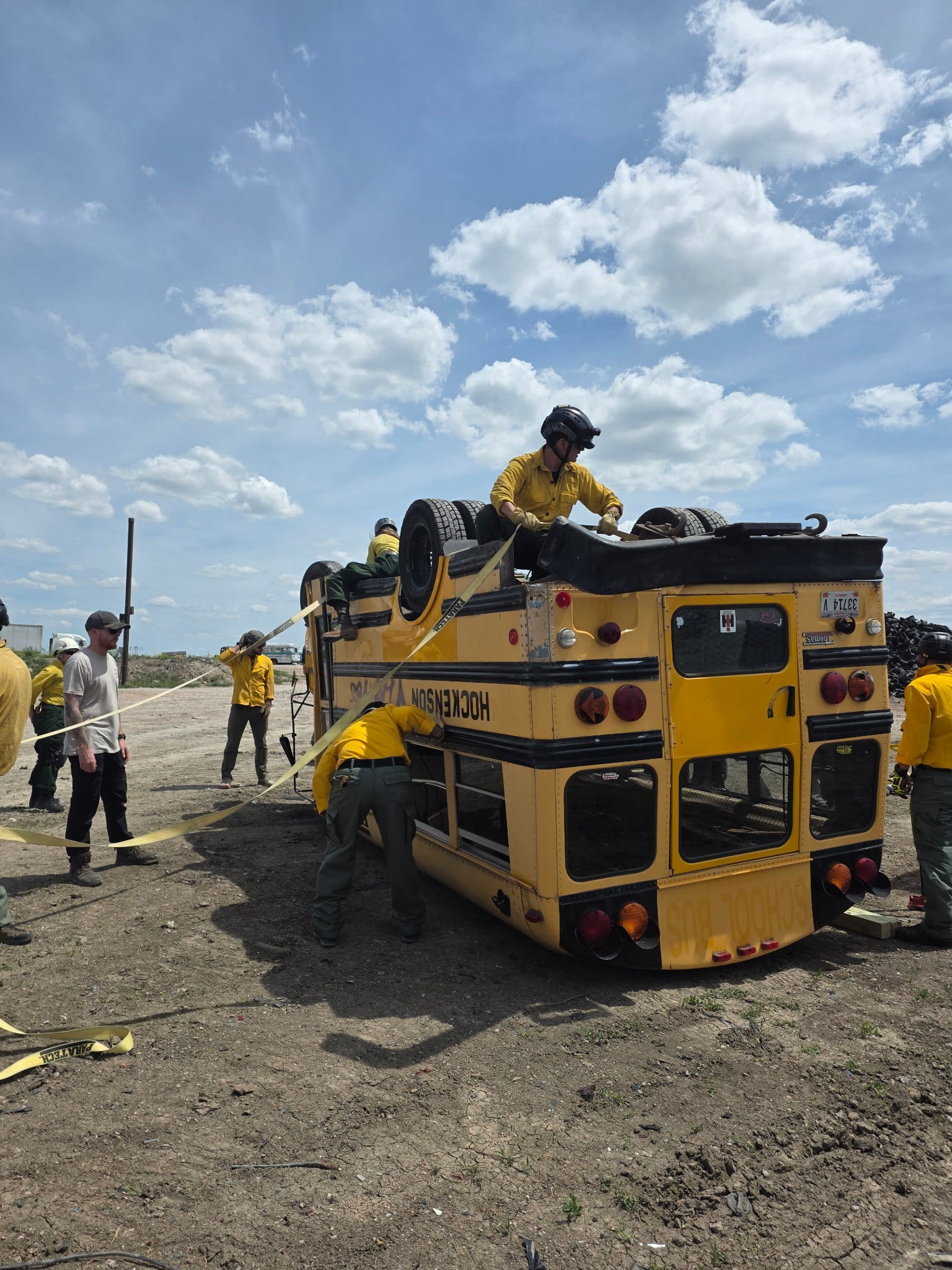
We met up at a junkyard on the outskirts of Rapid City. Cars were stacked on top of each other. An old Chevy and school bus were flipped upside down in the middle of the yard. The sun was hot, but the breeze was nice. I had never been to an auto extrication training, so I resorted to following orders.
“Put on your PPE (fire gear, helmet, gloves, and eye protection) and go meet up by the black truck. You’ll get more info from there.”
Standing over there were some guys that I had met two years ago during the first REMS course. All good men, skilled, and very funny. Whether the felt the same doesn’t matter, but to me it was like seeing old friends. We picked up from where we left off.
That boosted the mood, but now it was time to learn.
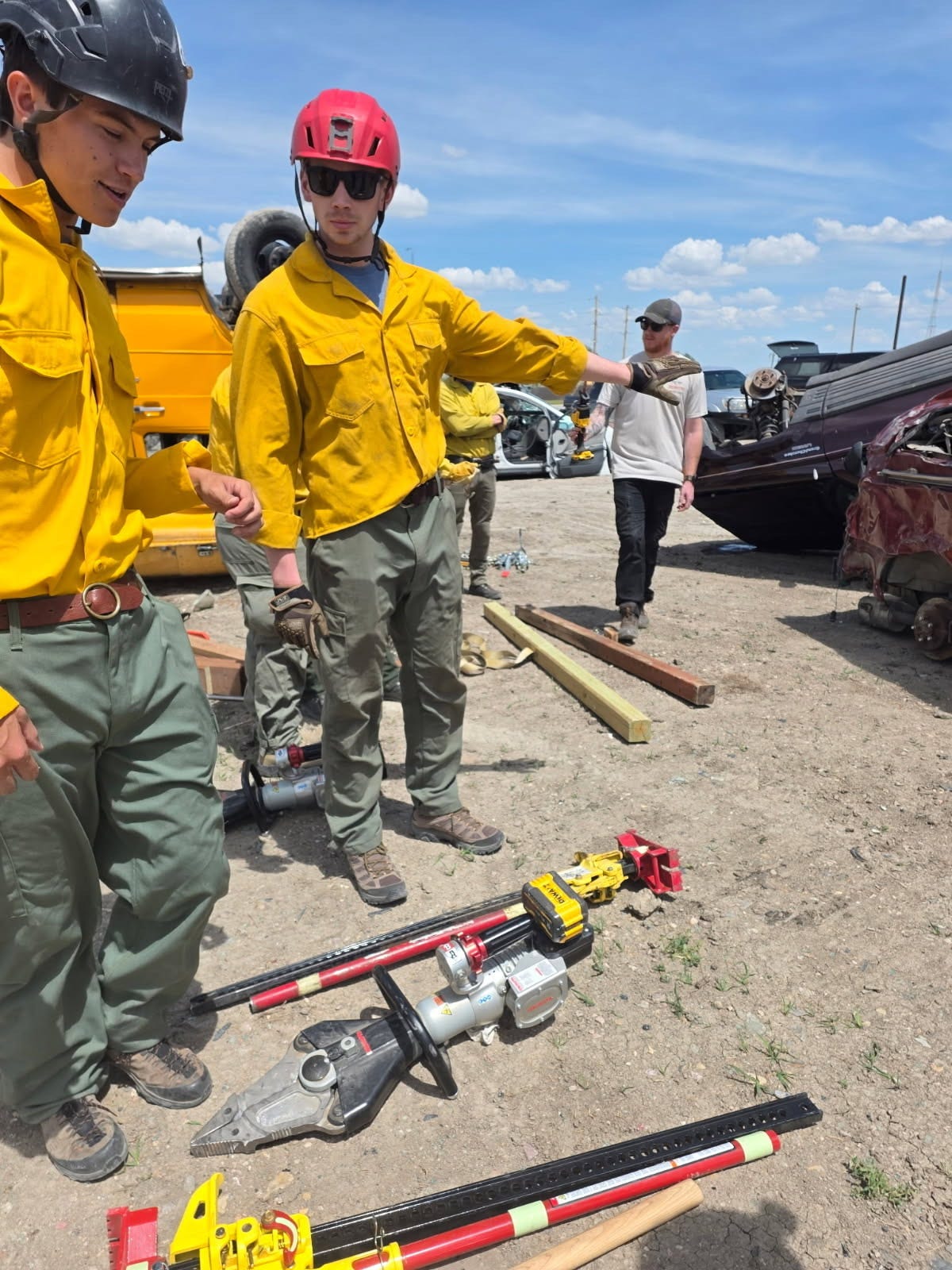
For the rest of the afternoon, we learned how to stabilize cars and bust open (or cut into) car frames or doors using haligans. We also used a smaller version of the “jaws of life” that structure firefighters use once in a blue moon when it’s finally time to be a hero. It’s tough work sitting around in a firehouse all day with your buddies. Just remember, as soon as you get the title, you inherit the reputation of all those firefighters who died on 9/11. No matter what you do, you’re just as cool, badass, hardcore, and good-willed.
Man, it’s nice to get that little jab in.
Moving on…
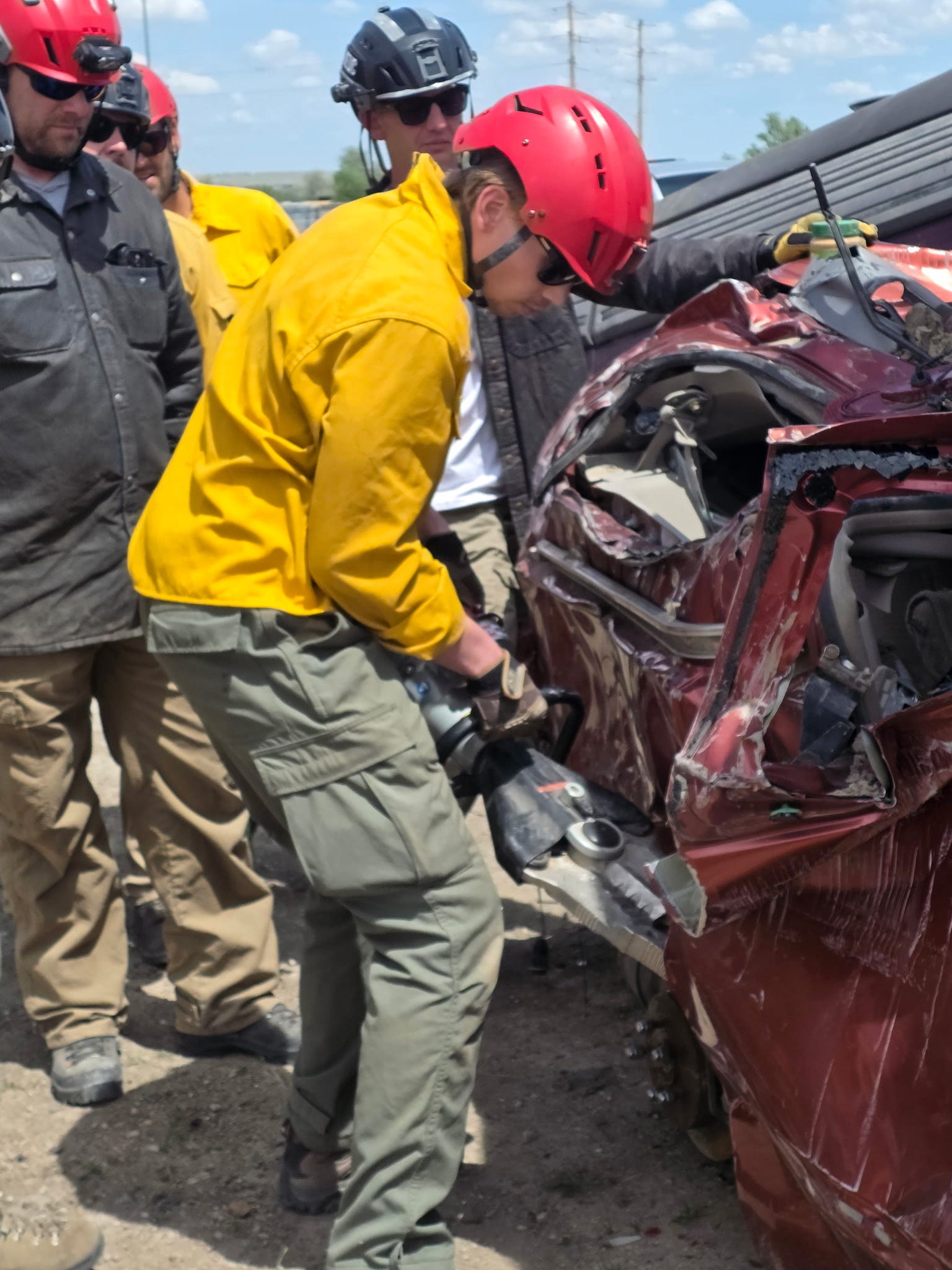
I had the chance to cut a couple doors off during the exercise. Holding up a 60 pound tool is no fun—and positioning it can be tricky—but watching a door crumble apart and eventually pop open is genuinely fun. Overall, it’s a great skill to have, but just as important is the ability to properly stabilize a car (or school bus) after an accident.
Those preventative measures can save you a lot of time or from serious injury.
Rope Rescue
Each day was split into 2 parts: rope-only work and medical+ropes.
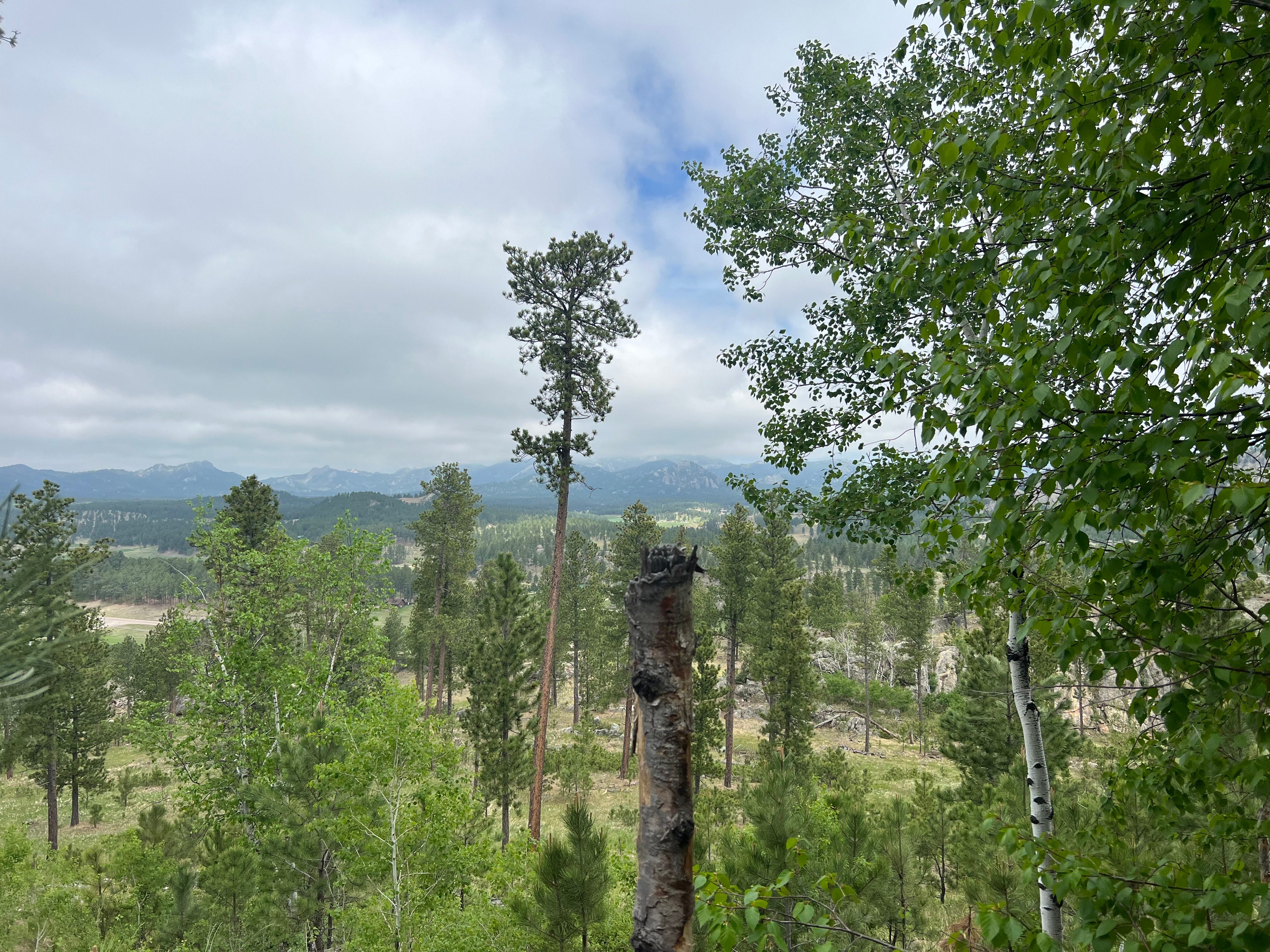
Once the auto extrication course was over, we headed to Custer, SD to set up camp in an outdoor training facility. The Black Hills are beautiful and offer a top-tier place to train due to the rugged terrain and steep rock faces. We barely had to walk 30 seconds away from camp until hitting a good rappelling spot.
What little I had managed to remember from the first REMS training came back to me quicker than I’d imagined it would. I understood how to use rappelling devices like an ATC in conjunction with a VT Prusik for a backup. To use these two devices as an example, the ATC attached directly to your harness and is a very simple rappelling device. However, you can attach a Prusik (essentially a small rope that you wrap around the primary line and attach to your harness as an additional level of safety) to the main line as a backup just in case the ATC fails.
Redundancy is a major part of rope rescue…or using ropes in general.
That all came back to me fairly quick, but what pleasantly surprised me was the fact that I could finally fully grasp how to build basic raising and lowering systems.
What do I mean by raising and lowering systems?
Well, let’s say that you came in contact with a patient in the backcountry, or wildfires, for example. Let’s also say that they fell down part of a cliff and sustained a broken tibia (compound fracture) and a traumatic brain injury (TBI). A helicopter or ambulance can’t get to them due to terrain. Our job is to use our knowledge of ropes to get the patient to a place where they can be transported to a hospital.
We hike in or drive in with UTVs, locate the patient, treat them, and use the terrain to build a system that either raises them up a cliff, hill, or mountain…and a lowering system does the opposite. Each of our harnesses carry a set of devices that either create friction, allow steady flow of a rope, can be attached to a rope, or capture (hold onto) the rope.
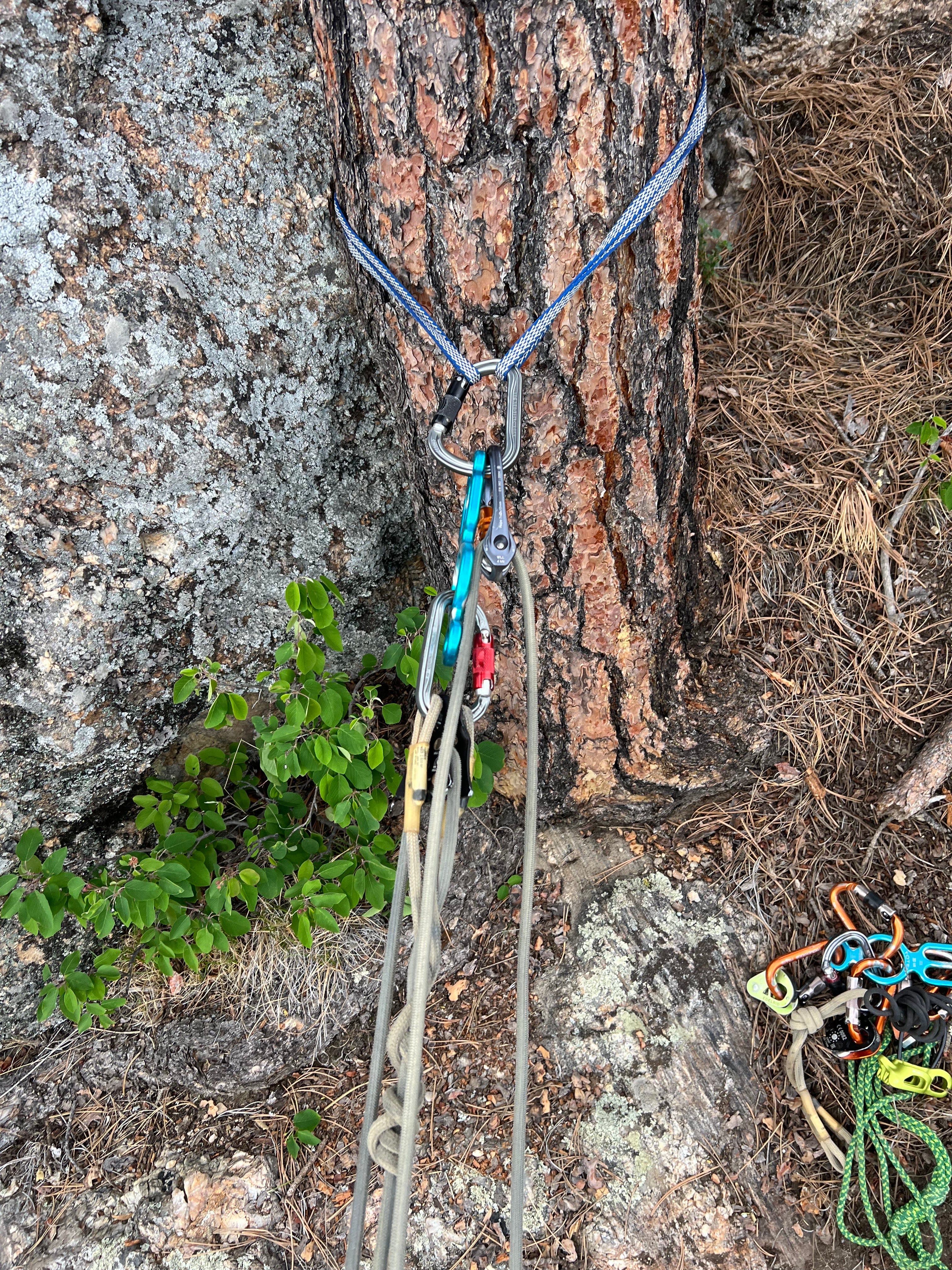
The rope systems can look complex, but many of them are fairly simple. Only a basic understanding of what you’re trying to accomplish and what each device does stands in your way of getting the job done.
For the most part, we stuck to building 3-to-1 systems. Meaning that for every 3 feet of rope we pulled at the top (trying to lift a patient) the patient would be moved 1 foot. There are many variations of rope systems and different times to use them, each one has its pros and cons. For example, if you need to lift a ton of weight (perhaps literally) you could build a 9-to1 system. The problem is…for every 9 feet of rope you pull, only 1 foot of rope could move.
It’s a process of trial and error. A process you have to shrink down to seconds or minutes when you’re doing it in the real world.
I feel as though I walked away with a solid level of competency this time around.
Medical Scenarios
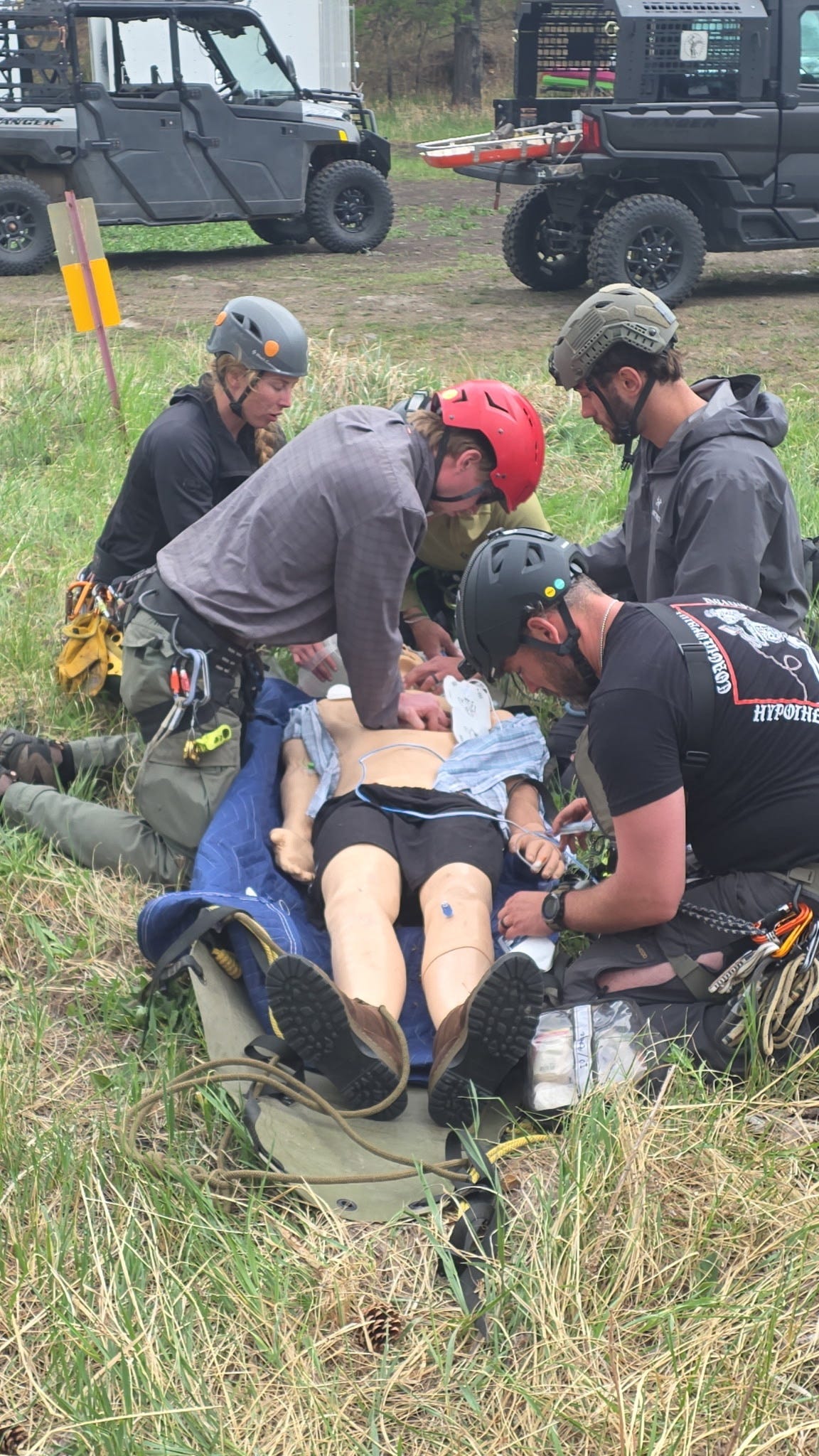
We had a huge opportunity. A local college allowed us to train on some of their expensive dummies…and no, I’m not talking about the professors. Just a joke, take it easy.
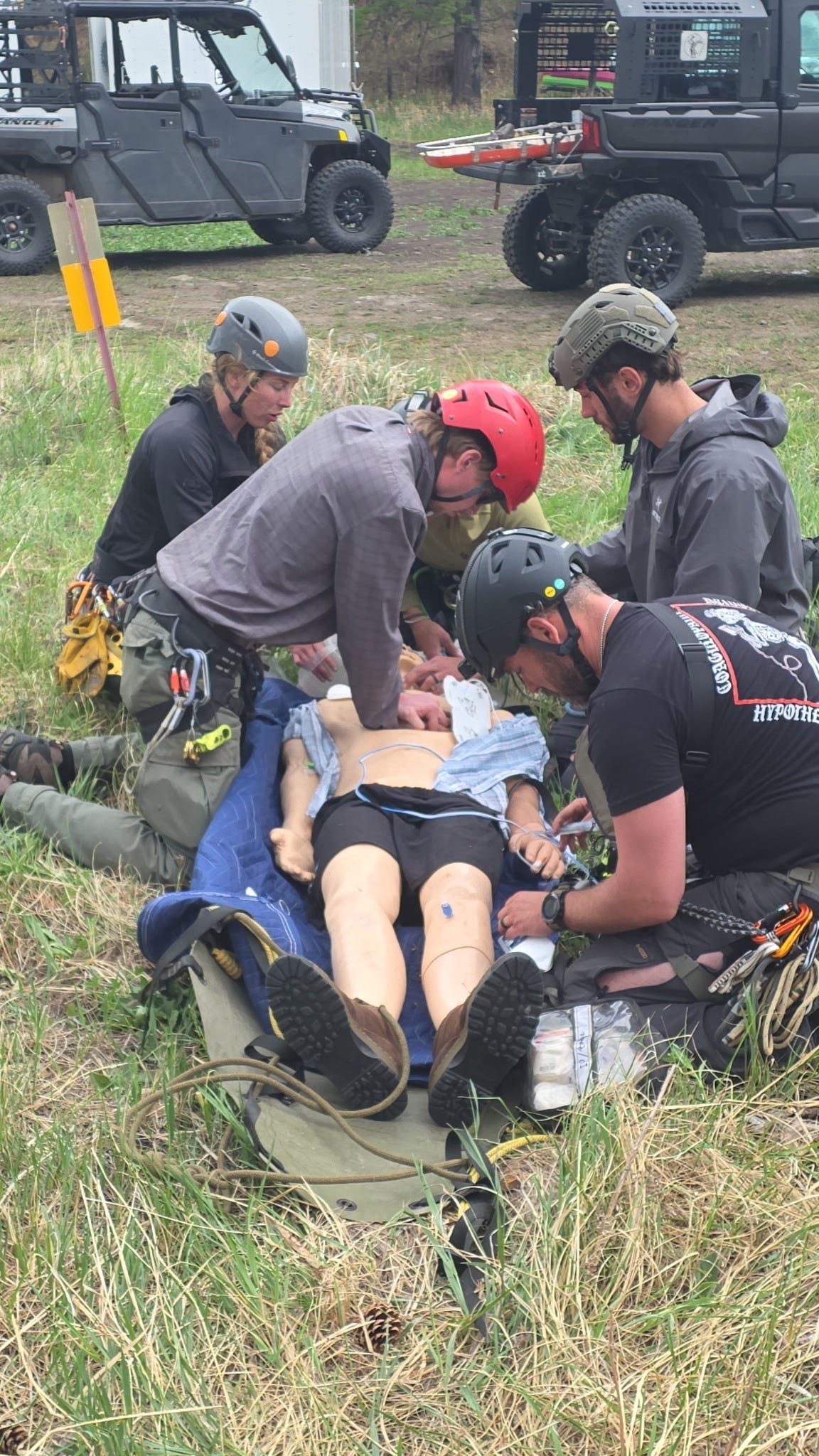
These dummies could talk, blink, breathe, and you could even drill an IO into them to administer certain medications through the bone. Of course, only the paramedics could do that. Plus, these dummies were heavy. One of them must have weighed about 200 pounds.
Each dummy had its own medical “problem”, and they were placed around the property. Some had traumatic brain injuries, some had heart attacks, some had broken bones. For each scenario, we had to assess them (figure out what happened), treat them to the best of our ability in the given timeframe, and build rope systems to raise them up or lower them down rock faces.
Each scenario went pretty darn good.
Our final scenario on the last day was the most interesting…
They had us load up in a UTV as if we were on a wildfire, drive out to a location a couple of minutes away, and listen to the radio for the call.
The call came in and it turns out that a mass shooter had killed a few people in the camp. The shooter was dead, but several patients laid strewn out around the camp for us to find and treat. We rolled up on the scene. Another EMT and I were assigned to 1 of the 2 human “patients”—a woman with a gunshot wound to the abdomen. Funnily enough, this patient was Tyler’s girlfriend. She’s Puerto Rican and was speaking Spanish to try to throw off any EMTs or Medics during the scenario.
“Oh, hablo Espanol”, I said.
I started speaking to her in Spanish, trying to ask her questions. Turns out I was the one that threw her off. It was funny.
What wasn’t funny was how the shock of the scenario caused me to pause too much instead of acting in the moment. That’s what training is for. The only thing I wish I had was more experience. Personally, my care for the patient could have been better. If I had done a more thorough assessment, I would have found that there was an exit wound. I would have gotten the shirt off faster and bandaged the wounds in a more timely manner.
I’m not upset about it. Many good things have come from my own failure.
Usually, I’m reminded of a quote from Napoleon Hill that goes something like, “Every defeat brings with it the potential for an equal or greater success.”
But the patient died. She was going to die in the scenario no matter what we did. Again, it was kind of funny during the scenario. For a brief second, we thought it was our fault.
Once she was gone, I moved on to helping another EMT and paramedic splint a compound fracture and bag a patient (meaning that I helped them breathe through a bag valve mask) until the scenario was over. Overall, it was a great time and a wonderful test of skill. What made it better was the people. I’m always impressed by Brennan and Tyler’s (founders of Minuteman EMS and The Journeyman App) ability to bring together a group of seriously good people.
It was a good week.
Reading
Finished reading The Revenant by Michael Punke
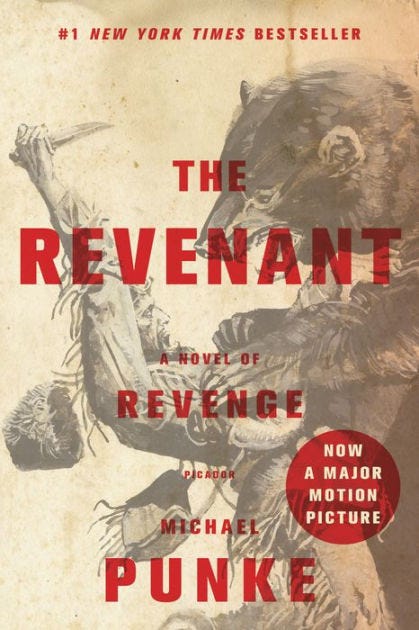
While the entire story in the book isn’t all true, the core of it is. Hugh Glass, a man who went on a trapping expedition during the early 1820s, was attacked by a grizzly and left to die by the men who were supposed to take care of him. He suffered day after day to find those men who left him for dead and take his revenge. Eventually, he found them. That part of the story is all true. The rest is lost to history. No doubt, he encountered hostile indians, nearly died of infection, starved, and froze. Hugh Glass really does show us just how much we can endure. I highly recommend this book. Excellent story.
Started reading Dreams of El Dorado by H. W. Brands

Are these updates informative? Are they useful? Entertaining?
Leave a comment below if you’ve got any suggestions or questions for me.
And don’t forget to send this to someone who might benefit.
I’ll see you next week.
-Maxim Benjamin Smith
I am acting as a guinea pig for a program which is meant to prepare young men for the future. This program is designed to be a replacement for the only three routes advertised to young men today - go to college, the military, or a dead-end job.
All of these typical routes of life are designed to shape us into cogs for a wheel that doesn’t serve us. Wasted time, debt, lack of skills, and a soul crushing job define many who follow the traditional route.
This program, which we can call “The Preparation”, is meant to guide young men on a path where they properly utilize their time to gain skills, build relationships, and reach a state of being truly educated. The Preparation is meant to set young men up for success.
What appeals to me about The Preparation is the idea of the type of man I could be. The path to becoming a skilled, dangerous, and competent man is much more clear now. I’ve always been impressed by characters like The Count of Monte Cristo, men who accumulated knowledge and skills over a long period of time and eventually became incredibly capable men.
Young men today do not have a guiding light. We have few mentors and no one to emulate. We have been told that there are only a few paths to success in this world. For intelligent and ambitious people - college is sold to us as the one true path. And yet that path seems completely uncertain today.
We desperately need something real to grab onto. I think this is it.
I’m putting the ideas into action. Will it work? I can’t be sure, but I’m doing my best. I’m more than 60 weeks into the program at this point. So far, so good.
You can follow me along as I follow the program. Each week, I summarize all that I did.
My objective in sharing this is three fold:
Documenting my progress holds me accountable.
I hope these updates will show other young men that there is another path we can take.
For the parents who stumble upon this log, I want to prove to you that telling your children that the conventional path - college, debt, and a job is not the foolproof path you think it is.
Always good to hear from you! Keep learning
Sounds like you had a great week and it's impressive that you remembered as much as you did. I imagine if you did the same week in two years, you would still learn even more and at the same time be much more proficient!